Now you can build your own vertical wind turbine from parts found at the hardware store and online. Applied-Sciences.net has given all of us open source plans for a DIY vertical wind turbine!


Now you can build your own vertical wind turbine from parts found at the hardware store and online. Applied-Sciences.net has given all of us open source plans for a DIY vertical wind turbine!
Next time that a big storm hits your town and knocks out the electrical grid, don’t think about how nice it would be to have a gas guzzling, smelly generator to run you fish tank and lava lamps. Think instead of a biomass generator. This interesting technology has seen some advancements that have made biomass power generation a hands-off operation that users expect from their emergency equipment. Of course, the technology can be used for all sorts of power needs. All Power Labs is a company leading the way in developing this clever technology; they have an interesting past and a bright, progressive future.
The generator first converts woody biomass (like wood chips, acorns, corn husks, etc.) to a gas; this is certainly the most complected step which this guide explains much better than I can. An engine is then used to burn that gas to produce mechanical or electrical power.

Better World Betty is a local grassroots organization dedicated to empowering people and business with the tools they need to be sustainable. They have really helpful information about how to recycle tricky items, find greener options, and make your everyday life more earth friendly. They also keep tabs on everything effecting the environment in the Charlottesville area and can answer any green questions that you may have!

Here’s a great little article telling of the financial incentives of making your existing place more energy efficient. In a lot of cases, payback on energy improvement renovation investment is just a few years!
Join us at the James River Green Building Council luncheon on Tuesday, July 9th 12:00 — 1:00pm to learn about ways to think more about the total environmental impact of products!

Don’t forget to join us today at the James River Green Building Council luncheon on Tuesday, June 11th 12:00 — 1:00pm to learn about how to make our built environments more resilient!

Architecture 2030 is a team of non-profit crusaders that want to radically transform the way that structures are built and how they interact with the environment. The 2030 Challenge is much like the EPA’s very successful CFC reduction program that let the Ozone Hole repair itself. Instead of CFCs, this challenge is to phase out the use of fossil fuels in buildings by the year 2030.
Not to leave everyone hanging wondering how to accomplish this goal; they are developing a great free resource of information on how to build carbon neutral and resilient structures and plan resilient communities which is called the 2030 Palette. The website is complete with pictures, descriptions and rules of thumb for many concepts vital to low impact built environments. Check out this fantastic tool for Architects, Engineers, Owners and people who want to learn more about how our buildings interact with the environment.

Resilience: The ability to recover readily from illness, depression, adversity, or the like; buoyancy. That’s what the dictionary says. More importantly though, as climate begins to change and the natural world bombards us with more and more challenges, how will we design our living systems to take these new challenges in stride? Resiliency and Sustainability are two terms we have begun to hear very often especially in building circles, but resiliency often gets replaced with redundancy. Resilience.org has a lot to say about the topic, so I’ll let them be your guide:

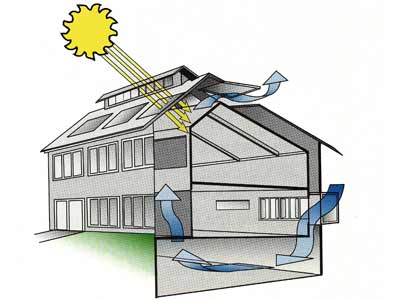
The double envelope passive solar house concept is explained well by Enertia here. The double envelope can obviously be expensive and I believe that is why it has a hard time being adopted as a mainstream building technique, but it can drastically cut energy bills if done correctly. Using the sun as a heat pump and fan while taking advantage of massive walls and southern windows make for a very efficient home indeed.
 The Housing Lab