Posts Tagged With: environment

“Birdland” The Village

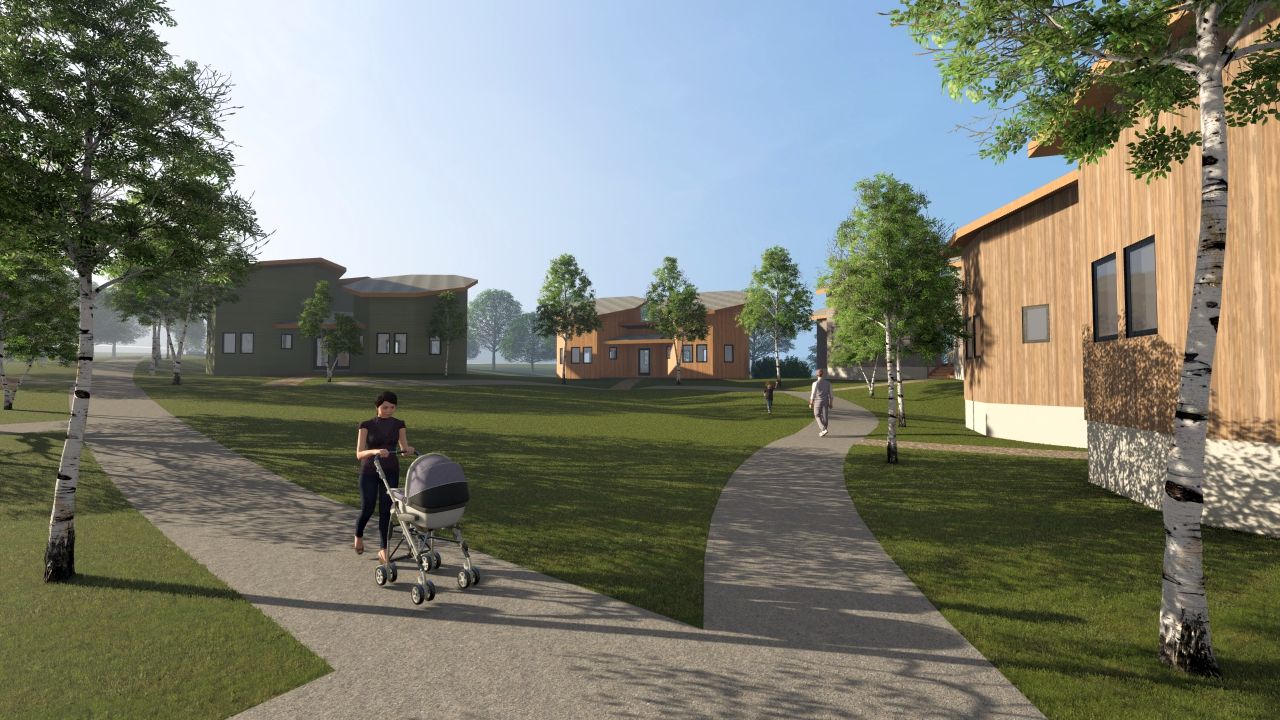
We can begin to tackle both the housing and loneliness crisis when clever, compact, kit housing design and clever site planning work together to create a neighborhood that feels like a village.


An Octagonal Housing Solution
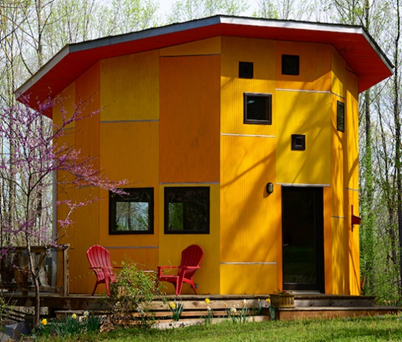
The team at Sculptorhouse believes it is possible to create housing that can provide this for many of the people that currently do not have access to such a home.  Sculptorhouse creates affordable housing that looks and feels like luxury housing.

They have designed, engineered, and prototyped a low-cost, eco-friendly house kit –The Octagonal Living Unit (OLU), to creatively address the many aspects of the housing crisis. The design for the OLU draws on the founder’s thirty-year career as a sculptor to create something unique and visually appealing but also beautifully proportioned and spacious. By creating the house in the same way a sculptor creates art multiples (like Rodin’s The Thinker that is modeled once and cast in bronze many times) Sculptorhouse is able to significantly reduce the per-unit cost. The octagonal shape increases efficiency in floor space, heating and cooling, and resistance to wind and seismic events. The result is a house of high quality and high visual appeal but at an affordable cost.

An octagon encloses twenty percent more floor space with the same materials as a rectangle. It is more efficient to heat and cool and more resistant to wind and seismic events. The interior space of an OLU is an open-plan space, giving long sight lines across the space and a breathtaking 16-foot-high cathedral space in the living room. The Sculptorhouse octagon is light filled from all points of the compass, allowing the sun to light it up with a glow in the early morning to the late afternoon.

This powerhouse little dwelling is built from an innovative building system that uses materials – galvanized steel and expanded polystyrene – that cannot be destroyed by water, will not rot, has no nutritional value for any vermin, and will withstand extremely high winds and severe earthquakes. Sculptorhouse kits are made from components that are created by manufacturers already operating at high capacity: the structural insulated building panels (SIPS) come from Thermasteel and the windows and doors come from Marvin. The small amount of lumber is sourced from local building suppliers. Most homes use thousands of elements. Sculptorhouse kit homes are built with SIPS panels that serve as structure, insulation, sheathing, and vapor barrier on one piece so they use about two hundred parts, creating significant savings in labor costs and time at the job site. When situated on permanent foundations and framed from steel, they are more resistant to wind and seismic activity than conventional homes.


A Pocket Village Solution
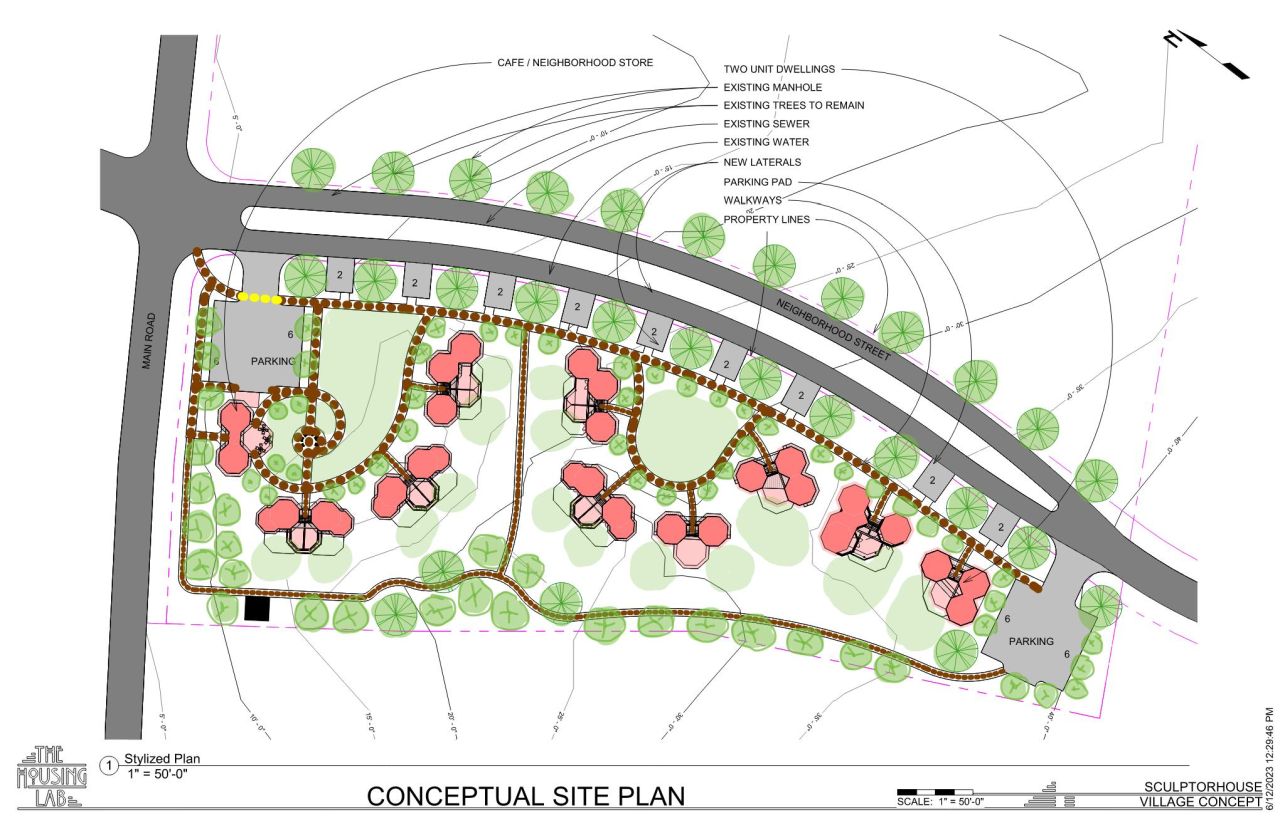
The site studied by The Housing Lab is located within a bikeable mile of downtown with water, sewer, and electric next door. It is a previously cleared infill site situated between a suburban neighborhood that is populated with mid-century ranches and a fairly dense development of townhouses. The design that will integrate best with the neighborhood is something that is a bridge between the townhouses and the single-family houses. The plan uses two-story versions of the Octagonal Living Unit connected in various ways to create two family dwellings in a variety of configurations.

  The concept for the site plan is unique in a few subtle but powerful ways:

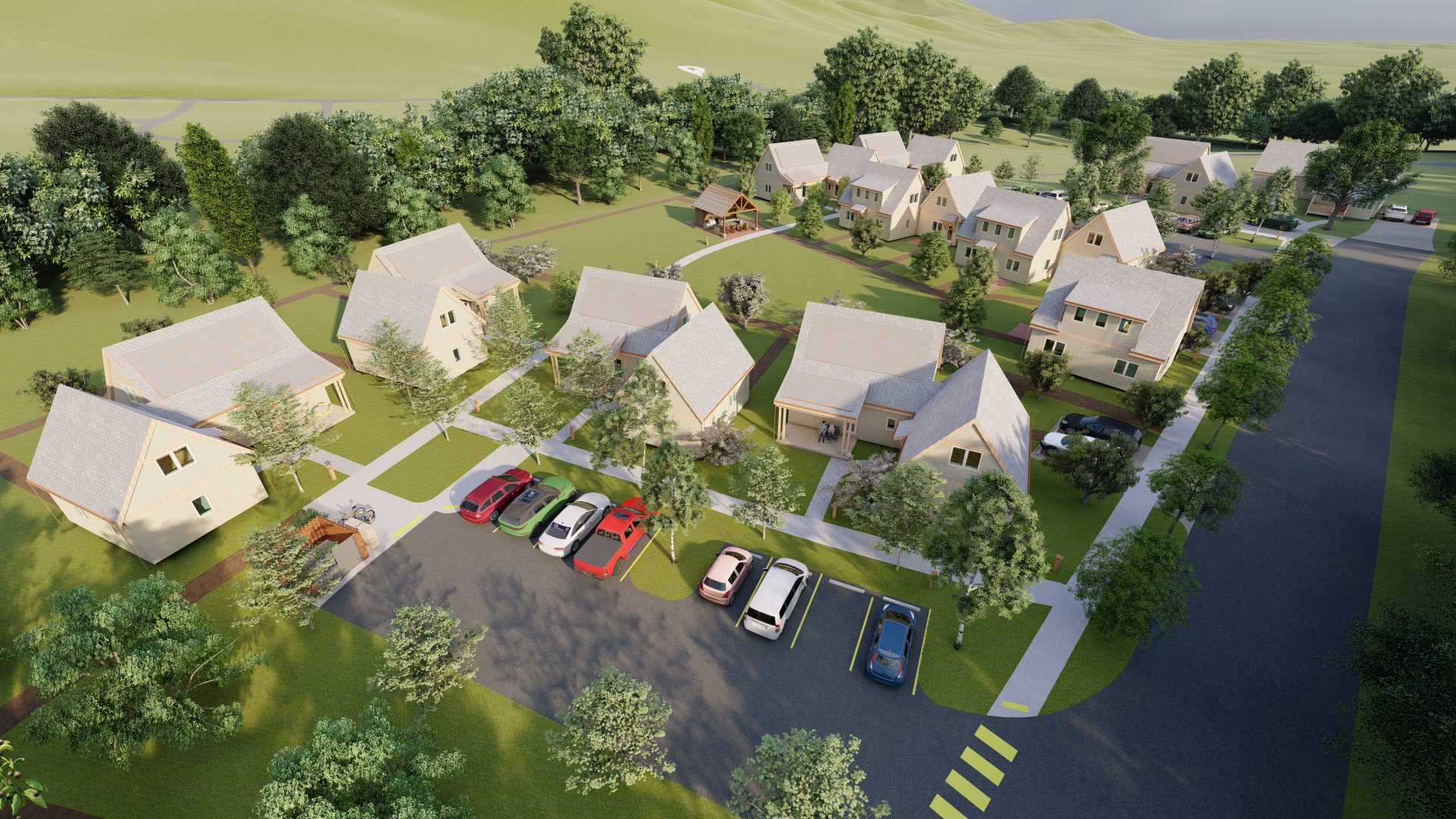
  1. The parking is pushed to the edges of the site which not only costs less by building less impermeable driveway surface, but also opens the interior of the site for more shared greenspace.
  • The structure on the corner of the main road and next to the parking area is intended to be a neighborhood cafe or general store, creating a third place to walk to for the surrounding neighborhoods and bringing life to the corner.
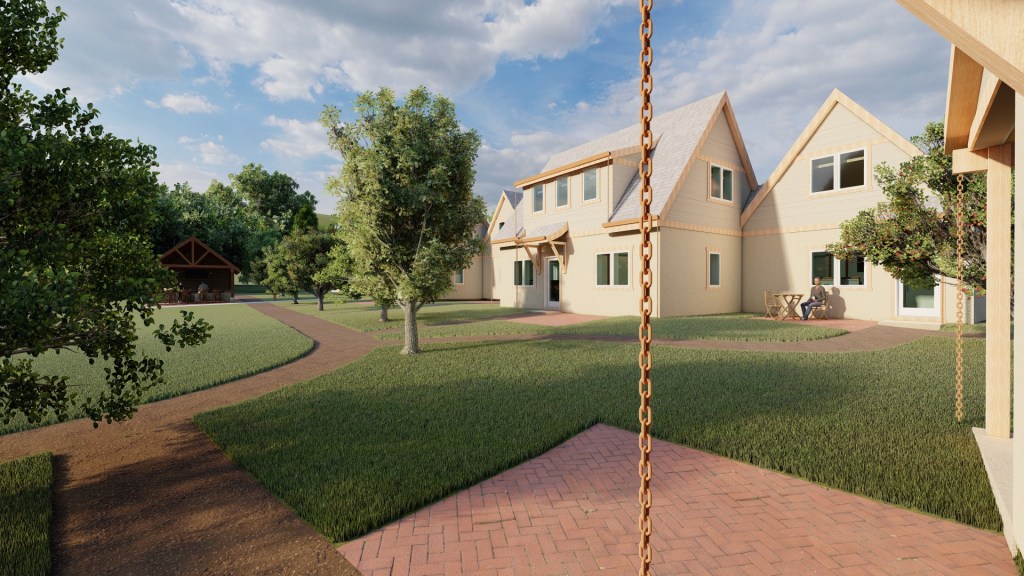
  • The houses are arranged to create two public greenspace “rooms” that lead to most of the main entrances, encouraging spontaneous conversations for adults and playdates for children.
  • Even though the houses are attached as two-family dwellings, the unique angles of the Sculptorhouse units and the way they are attached create a private back yard for all the houses.
  • As a benefit for the entire community, a walking trail runs along the back of the site
  • The concept is flexible enough to be applied to the many different shapes and topography of infill sites, like this second site just around the corner from the first site studied. Its location doesn’t make a commercial space viable, but all the other patterns fit nicely. This site design preserves its seasonal stream buffer and wooded areas by focusing the neighborhood only on the previously cleared areas next to the existing roads and services.

Contact The Housing Lab or Sculptorhouse if you would like more information or are interested in bringing this kind of concept to life!
Categories: Uncategorized | Tags: , , , , , | Leave a comment

2023 Sustainability Symposium

Green Building United’s 13th annual Sustainability Symposium is just around the corner! This will be an all day event of 20+ educational sessions, expo hall, tours, and networking opportunities, showcasing the region’s most innovative green building, sustainability, and industry best practices. Join our partner Green Building United on May 24th, at Drexel University for this truly informative event! #GreenBuild23 https://lnkd.in/gyNqM7U4

I’m excited and proud to be speaking about the environmental impacts of different HVAC and hot water system choices with Staengl Engineering and Passive to Positive

Categories: Announcements, Design, Education, Energy Efficiency, Technology | Tags: , , , , | Leave a comment

Minimizing Carbon in Multifamily Systems

Have you ever wondered how different conditioning, ventilation, dehumidification and domestic hot water systems stack up to each other in energy usage and carbon impacts? I hosted a webinar on Passive House Accelerator analyzing just those questions for a real passive house apartment building in Pittsburgh. Check it out if you want to expand and refine your HVAC mental models! In total, 14 different HVAC/hot water system types are discussed; they were all modelled and analyzed for their embodied carbon, operational carbon, and refrigerant leak impacts.

Categories: Announcements, Design, Education, Energy Efficiency, Materials, Technology | Tags: , , , | Leave a comment

phius con 2022

I’m thrilled to be presenting about Radical Decarbonization with Michael Hindle from Passive to Positive at PhiusCon 2022 in Chicago! Pre-Conference starts Oct. 25, so secure your ticket now. 

Register here: https://www.phius.org/phiuscon/register-phiuscon-2022 

#phiuscon2022 #phiuscon #passivebuilding #passivehouse #passivehouseconference #netzero #sustainability #chicagoconference 

Categories: Announcements, Design, Education, Energy Efficiency, Materials | Tags: , , , , , | Leave a comment

Mcallister Village: Walkable, Adorable, Affordable

The Mcallister Village concept is to create a neighborhood of small starter homes a short walk from coffee shops, restaurants and the future downtown Crozet. The site is designed to push the parking to the outside, create courtyard entries to all the houses, open up a shared central green with a shared pavilion, and be enhanced with perimeter walking trails. This idea was inspired by The Boiceville Cottages in Brooktondale, NY not far from Ithaca, NY

The houses will be compact one bedrooms with lofts attached to compact lofted two bedroom or three bedroom houses. The one bedroom houses fit somewhere in-between apartments and single family detached houses in the market; a segment largely ignored for decades due to outdated zoning codes. The houses utilize a versatile lofted design to provide more storage and living area for singles, couples and young families. The construction details are simple and elegant; reducing cost, increasing thermal efficiency and maximizing space.

The proposal asks to either fix the blatant mathematical errors in the R-2 zoning code or rezone the property to PRD (Planned Residential Development) from R-2 to allow for our creative redesign. The total amount of families would be the same as by-right, but the by-right attached accessory units (adus) would be expressed as more desirable attached one bedroom cottages that can be bought or rented separately:

This project is currently shelved unless a forward thinking developer wants to take on securing the property and going through the county rezoning process. Contact us for more information

Categories: Architecture, Communities, Design, New Urbanism, Preservation, Tiny Housing | Tags: , , , , , , , | Leave a comment

Green Building March 10th Luncheon: Leadership Panel

Hear from founders in the Charlottesville sustainability movement in this dynamic panel discussion. Panelists will share their experiences with careers in green building and sustainability, as well as advice for future generations. Come be inspired by local leaders and gain insights on building sustainability into your work and personal endeavors. This is the first in a series of thought leadership presentations across Virginia in 2020.

Our Charlottesville panelists include:

  • Bob Crowell, 2RW
  • Susan Elliott, City of Charlottesville
  • Annette Osso, Resilient Virginia
  • Galen Staengl, Staengl Engineering

Lunch will be provided

This presentation is approved for I GBCI CE credit

Fee: $10 for members and $20 for nonmembers.

Lunch will be served, Register Here

Our meeting space is generously donated by the City of Charlottesville.

DATE AND TIME
Tue, March 10th, 2020: 12:00 PM – 1:00 PM EDT
LOCATION
City Space, 100 5th Street NE, Downtown Mall, Charlottesville, Virginia 22902
Categories: Announcements, Design, Education | Tags: , , , | Leave a comment

Green Building February 11th Luncheon:

The Charlottesville Climate Collaborative empowers individuals and businesses to be climate leaders with strategies to take action. This presentation will provide practical solutions to help you make a positive impact and achieve sustainability goals in your lifestyle, business, and community.

Speakers:

Andrea Bostrom

Andrea is the Charlottesville Climate Collaborative’s Residential Program Manager. Andrea began her journey into advocacy as a high school student in the Deep South, holding the enviable title of President of the Students for Environmental Awareness club. A native of Alabama, she grew up eating home grown tomatoes, communing with horses, and riding her bike through peach orchards. She took her passion for the environment towards a Bachelor’s degree in Environmental Engineering from Louisiana State University and a Master’s Degree in Civil and Environmental Engineering from the University of Texas – Austin. Andrea has spent almost two decades as an engineer, policy maker, and program manager in both the public and private sectors. She served as the program manager for the flood protection program at the City of Austin’s Watershed Protection Department for seven years before relocating to Charlottesville in 2014. She served as Director of the Charlottesville Waldorf School before joining C3 in September 2019.

Claire Habel

Claire Habel, C3’s Commercial Program Manager, grew up in Minnesota exploring the natural world. At C3’ she is running the Better Business Challenge as well as our Green Schools network. She graduated from DePaul University cum laude with a Bachelors in Intercultural Communication and earned her master’s degree in Environmental Communications & Advocacy from James Madison University. Most recently Claire worked with the City of Charlottesville’s Environmental Sustainability Division and Office of Communications. Claire is passionate about engaging businesses to promote sustainable practices.

Lunch will be provided

I GBCI and AIA CE credit pending approval

Fee: $10 for members and $20 for nonmembers.

Lunch will be served, Register Here

Our meeting space is generously donated by the City of Charlottesville.

DATE AND TIME
Tue, February 11th, 2020: 12:00 PM – 1:00 PM EDT
LOCATION
City Space, 100 5th Street NE, Downtown Mall, Charlottesville, Virginia 22902
Categories: Announcements, Communities, Education, Resilience | Tags: , , , , , , , , | Leave a comment

Green Building December 10th Building Tour: First Passive House in Virginia: Ten years in

Tour the first Passive House in Virginia with the General Contractor and Owner as they explain the intentions going into the project and lessons learned. Lankford Passive House has three bedrooms, two-and-a-half bathrooms, and about 2,250 square feet.

The green home has triple-pane Serious Windows 725 Series, double-stud wall framing, FSC-certified framing lumber and plywood, structural insulated sheathing with taped seams, a hybrid wall with nine inches of Agribalance open cell spray foam and cellulose insulation, a roof with Agribalance open cell spray foam and two inches of closed cell roof foam, a white roof, and an exterior with stucco and Western Red Cedar.

The home includes several other green elements, including a 1,100-gallon rainwater harvesting system, locally-sourced slate, regionally-sourced red oak floors with a water-based low-VOC finish, and building finishes from cherry and locust trees harvested on the site.

I GBCI and AIA CE credit pending approval

Fee: $5 for members and $15 for nonmembers.

Register Here

DATE AND TIME
Tue, December 10th, 2019: 4:00 PM – 5:00 PM EDT
LOCATION
229 Lankford Ave, Charlottesville, VA 22902
Categories: Announcements, Architecture, Design, Education, Energy Efficiency, Preservation, Technology | Tags: , , , , , , , , , , | Leave a comment

Green Building November 12th Building Tour: A Closer Look at UVA’s Clark Hall

Clark Hall is a mixed-use academic building that opened in 1932 to house the UVA School of Law, and currently houses the University’s Department of Environmental Sciences and Charles L. Brown Science & Engineering Library. It is home to classrooms, office space, a library, a café, laboratories, exhibits, lecture halls and a “wet lab.” Recently, the UVA Facilities Management energy conservation team (Delta Force) implemented a combination of energy and water conservation upgrades, converting all 5,000 interior and exterior fixtures from fluorescent lamps to LED, installing low-flow toilets and faucet aerators, recalibrating air handling units, and upgrading HVAC controls. As a result, Clark Hall achieved an annual energy savings of $750,000, or 65%, along with an annual water savings of $22,000, or 79%, relative to their pre-retrofit baseline. The Delta Force team also documented the sustainable operations of Clark Hall, and the U.S. Green Building Council awarded Clark Hall its “LEED V4 Existing Buildings, Operations + Maintenance Silver” certification, the first such project recognized in Virginia

Speakers and Tour Guides:

Doug Livingston – Doug is part of the energy engineering team and helps identify and implement energy efficiency and retro-commissioning projects across Grounds. He also works with various stakeholders on Grounds to improve the built environment in order to increase health and wellness for the UVA community. Prior to joining UVA, Doug was the Program Manager of the Green Building Services department at Harvard University. Previous to Harvard he worked as a consultant doing HVAC and plumbing design, energy modeling, and energy conservation. He has a Bachelor of Science and Master of Science in architectural engineering from the University of Nebraska and he is a licensed mechanical engineer in the state of California.

Jesse Warren – Jesse is responsible for the University’s electric demand response and sustainable building programs. He leads a team of energy engineers who identify and implement energy efficiency and Delta Force retro-commissioning projects across Grounds. Previously, Jesse worked as a consultant doing energy conservation, HVAC design, energy modeling, and LEED project coordination. He has a Bachelor of Science in mechanical engineering from Virginia Tech and he is a licensed mechanical engineer in the state of Virginia. He is a proud father of three and a rain or shine two-wheeled commuter.

John Jones – John joined UVA in October 2010 after holding previous roles in the areas of facilities project management, physical plant operations, and mechanical and building automation systems contracting with various Virginia-based firms. He is currently responsible for evaluating, identifying and implementing energy reduction projects in existing university facilities at UVA. A few of his projects have included Gilmer Hall, Thornton Hall, West Complex and others. John holds a Bachelor of Science in engineering from Old Dominion University and is a licensed engineer in Virginia. He is also an accredited LEED AP BD+C and O+M as well as a Certified Energy Manager. Outside of work, John enjoys outdoor activities and music.

I GBCI and AIA CE credit pending approval

Fee: $5 for members and $15 for nonmembers.

Register Here

DATE AND TIME
Tue, November 12th, 2019: 4:00 PM – 5:00 PM EDT
LOCATION
University of Virginia, Clark Hall, 291 McCormick Rd, Charlottesville, VA 22904
Categories: Announcements, Education, Energy Efficiency, Preservation, Technology | Tags: , , , , , , , , | Leave a comment

Green Building October 8th Luncheon: Leveraging ENERGY STAR to Support Commercial Building Improvement and Achieve LEED Certification

ENERGY STAR is the premier program for recognizing energy efficient commercial buildings, and LEED is the premier program for recognizing sustainable green buildings. This session will provide valuable information to LEED practitioners to help them leverage ENERGY STAR as a means of moving buildings toward LEED certification. The program will present an overview of the ENERGY STAR program for commercial buildings, with a special focus on the program’s widely used Portfolio Manager software tool that allows building owners and managers to track and assess the energy performance of their buildings. Participants will then learn about how ENERGY STAR intersects with LEED EB: O&M, and how increasing performance through ENERGY STAR can help buildings achieve LEED certification, as well as how the relationship between ENERGY STAR and LEED may change under the proposed LEED v4.1 system. Finally, participants will be introduced to a host of other ENERGY STAR tools, resources, and initiatives that are aimed at helping to improve the energy performance of buildings, as well as opportunities to reduce water use and waste generation.

Speaker:

Jerry Lawson, National Manager, ENERGY STAR Small Business/Congregations, U.S. Environmental Protection Agency

I GBCI and AIA CE credit pending approval

Fee: $10 for members and $20 for nonmembers.

Lunch will be served, Register Here

Our meeting space is generously donated by the City of Charlottesville.

DATE AND TIME
Tue, October 8th, 2019: 12:00 PM – 1:00 PM EDT
LOCATION
City Space, 100 5th Street NE, Downtown Mall, Charlottesville, Virginia 22902
Categories: Announcements, Education, Energy Efficiency, Technology | Tags: , , , , , , , | Leave a comment

Blog at WordPress.com.